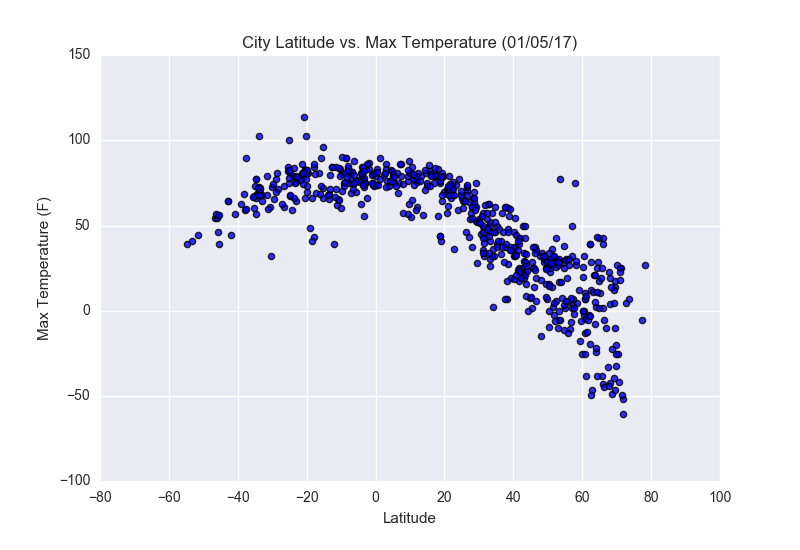
Temperature vs. Latitude
You can see from the figure that on average the temperature is higher at the equator and falls towards the poles. The amount of solar energy received at the surface of the earth decreases with latitude as the sun's rays become less direct, which is why the temperature decreases with increasing latitude.
The snap shot of the weather was taken on 5 Jan 2017, which is summer in the southern hemisphere and the sun is directly overhead at noon at 22.56 deg S. This is why January is the coldest month in the nothern hemisphere winter and the hottest month in the southern hemisphere summer. You can see that the average temperature at 40 deg N (about 25F) is much cooler than that for 40 deg S (just over 50F).
Temperature depends on many factors besides the latitude of the weather station. You can see this in the wide spread in the temperature. Look at how the spread increases for the latitudes above +40. At about 60 N the range of the observed temperature is from -50F to +75F!
Home