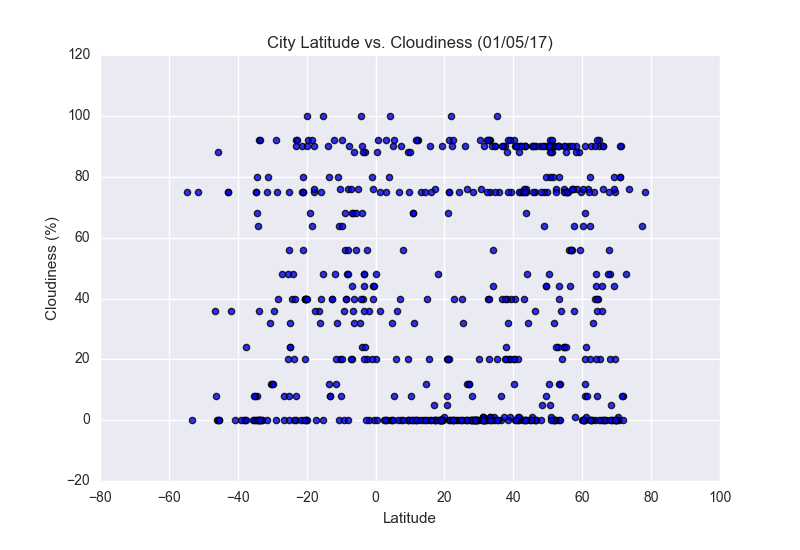
Cloud Cover vs. Latitude
Cloud cover has traditionally been estimated using observers who would go out and estimate the number of eights or oktas of the sky to the horizon that are covered. This information was mostly used for avaition at airports and landing strips for safety. Cloud cover has been one of the most difficult observations to automate with a measurement device. The closest instrument that can replace the manual observation of cloud cover is called a ceilometer. It is based on a pulsed laser that can measure the distance to the bottom of a cloud (cloud base) for clouds that are directly above the instrument.
The need to measure cloud cover fraction for avaition has been replaced by the need to measure and forecast solar radiation for use in the renewable energy sector. This is done though direct measurement of the solar radiation using a pyranometer. These instruments are difficult to maintain because they need to be cleaned before dawn each day. Satellites are used to detect the presence of clouds and their optical thickness.
The tropics have high cloud cover on average, especially during the monsoon seasons. There is a decrease in cloudiness in the sub-tropics (around 30 deg) due to the semi-arid areas that are found at these latitudes and an increase at the high latitudes, but this cannot be seen in the data that have been analysed.
Home